Is Your Furnace Affecting Your Indoor Air Quality?
The push to make our houses as energy-efficient as possible has, in some cases, led to unintended consequences. Because modern houses are less drafty due to tighter-fitting windows, doors and weather stripping, pollutants that were vented in the past are trapped inside. Most of the pollutants are relatively harmless, but some can be dangerous, and they all contribute to what some people call "sick house syndrome."
"Pollutants" is a broad term, and can include things like dust mites, pet dander, mold spores and viruses, as well as gaseous pollutants like tobacco smoke and the off-gassing from paints, cleaning products and some building products. They can lead to headaches, dizziness, irritation of eyes, nose and throat, fatigue and more serious illnesses. If you experience these symptoms while in your house, but not when you are away from home, indoor pollutants may be the cause.
The best solution is to remove the cause of the pollutants and ventilate the space with fresh outdoor air. Unfortunately, natural ventilation is not always practical. No one is going to throw open the windows on a cold winter's day, nor are they likely to open the windows if the house is cooled by a central air conditioning system—as the purpose of a tightly sealed home is to conserve energy.
However, you can also help remove some of the pollutants by upgrading the filter used in your forced-air heating and cooling system. The basic furnace filter is designed to keep dust and large particles out of the machinery, but more advanced filters can effectively remove pollutants, including viruses and odors, using a variety of methods. Standard filters simply trap particles on a flat filtering medium, while others have deep pleats with added surface area. Electrostatic filters provide an electrical charge that helps trap some particles more effectively.
Pick a Filter
There are a number of rating systems to help sort out the types of filters available. The systems will help you compare filters from different companies. The American Society of Heating, Refrigerating and Air-Conditioning Engineers (ASHRAE) developed the minimum efficiency reporting value (MERV) for filters. MERV rates filters on a scale from 1 to 20, with 20 being the most efficient at removing pollutants. According to the Environmental Protection Agency, filters in the 7 to 13 range are likely to be nearly as efficient as high-efficiency particle arrestance (HEPA) filters at removing airborne particles. Filters with higher ratings are used in hospitals, laboratories and clean rooms.
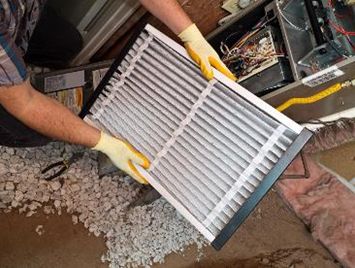
Be sure to buy the size filter that fits your system. The information should be in the owner's manual or on the furnace itself. If you don't have it, take the existing filter to the store with you. If you choose a high-efficiency filter, read the packaging carefully, as some need to be changed more frequently than others to function properly.
Inline purifiers are another option. These are installed inside the air ducts to remove pollutants. Some employ ultraviolet radiation to kill bacteria, allergens and mold. Others use a catalyst to oxidize pollutants (including gaseous ones), a process that converts the pollutants into harmless hydrogen and oxygen. Inline purifiers are usually used in addition to - not instead of - furnace filters.
Other Steps to Take
Installing a high-efficiency furnace filter is a good first step for tackling indoor air pollution. It's something that you can do right away, for little money—a premium filter will cost less than $25. However, it won't solve every type of pollution problem. Here are some other steps to take:
- Make sure range hoods, bathroom ventilation fans and dryer vents are all working properly. They vent moisture and odors to the outside. Getting rid of moisture vapor in bathrooms and kitchen will help prevent mold.
- Install carbon monoxide (CO) detectors in your home. CO is a byproduct of combustion, and if it accumulates in your home, it can be lethal.
- Have your house tested for radon. Radon is an odorless, invisible gas that is a byproduct of uranium that occurs naturally in the soil. If it leaches into your home, it can lead to serious illnesses. Test kits let you take a sample of air from your home and send it to a lab for results. If you do have elevated levels in your home, don't panic. Radon mitigation products are straightforward and simple to install.
Protect yourself from the pollutants in your air by replacing your furnace filter as needed, and making sure to ventilate your home with fresh air whenever possible.
About The Author
Want to estimate your home improvement costs before talking with a contractor? Claim your home for free with bluehammer to estimate costs, secure your home inventory and learn more about your home.
* THIS REPORT IS AN OPINION THAT MAY BE INACCURATE AND IS PROVIDED SOLELY AS AN INFORMATIONAL TOOL NOT DESIGNED TO PROVIDE DEFINITIVE ANSWERS. ALL ELEMENTS ARE OFFERED "AS IS" AND BLUEBOOK EXPRESSLY DISCLAIM ANY AND ALL WARRANTIES, REPRESENTATIONS, AND GUARANTEES OF ANY NATURE, EXPRESS, IMPLIED OR OTHERWISE, INCLUDING BUT NOT LIMITED TO ANY IMPLIED WARRANTIES OF MERCHANTABLITILY, NONINFRINGEMENT, TITLE, QUIET ENJOYMENT, ACCURACY, OR FITNESS FOR A PARTICULAR PURPOSE. IN NO EVENT SHALL BLUEBOOK (OR THEIR SUPPLIERS) BE LIABLE FOR ANY GENERAL, DIRECT, SPECIAL, INCIDENTAL, INDIRECT OR CONSEQUENTIAL DAMAGES OF ANY KIND, OR ANY DAMAGES WHATSOEVER (INCLUDING WITHOUT LIMITATION, THOSE RESULTING FROM USE OF THE PRODUCT, INCLUDING : (1) RELIANCE ON THE MATERIALS PRESENTED, (2) COSTS OF REPLACEMENT GOODS, (3) LOSS OF USE, DATA OR PROFITS, (4) DELAYS OR BUSINESS INTERRUPTIONS, (5) AND ANY THEORY OF LIABILITY, ARISING OUT OF OR IN CONNECTION WITH THE USE OR PERFORMANCE OF INFORMATION) WHETHER OR NOT BLUEBOOK HAS BEEN ADVISED OF THE POSSIBILITY OF SUCH DAMAGES.